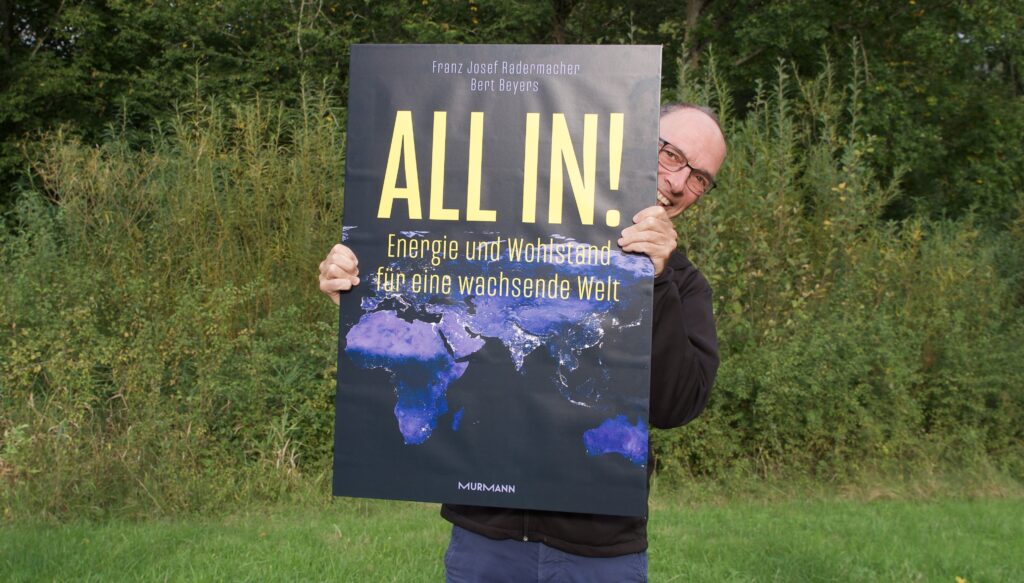
FAW/n and GES describe in their book “ALL IN! Energy and prosperity for a growing world”,
FAW/n and GES describe possible future energy paths to a climate-neutral world with prosperity for 10 billion people in peace with nature in 2050 – 2070. An essential requirement for the energy systems is that they contribute to climate protection. The components of the respective energy system are decided individually for each country/region. The most important components in the electricity sector are renewable energies (conventional as well as wind and solar) on the one hand and reliably controllable energies (fossil fuels with carbon capture and/or nuclear energy) on the other. These components describe the options available in the world today. Fossil energy sources currently still cover around 80 per cent of global primary energy requirements.
It is particularly important to us that every country finds its own way. Because without increasing energy use, billions of people will inevitably have to live in poverty, which would be a human catastrophe of unimaginable proportions. A changeover from an established energy system is often not feasible or financially viable, or only at exorbitant cost and with major collateral damage. In this respect, it is not possible to simply deviate from a chosen path. Increasing energy use for a growing human population is a “must”.
Individual elements of the solution space are sometimes vehemently rejected. This mostly concerns nuclear energy, which is practically free of CO2 emissions. Critics repeatedly point to the risk of nuclear waste and serious accidents such as those in Chernobyl and Fukushima. Statistically speaking, however, nuclear energy is one of the safest forms of power generation.
As the authors of “ALL IN!”, it is important to us first of all that we observe what happens, i.e. that we do not decide for ourselves. We describe options and analyse them from a technical, economic and regulatory perspective.
We see a considerable need for development in the nuclear sector and recognise that many leading economies are making efforts to use the considerable energy generation potential of these technologies in an environmentally friendly way in the future through innovation. As so often in history, technical progress opens up positive potential. Innovations are moving in the direction of smaller, inherently safer and also significantly more cost-effective systems (SMR systems). Added to this is the utilisation of the energy generation potential of fuel rods that cannot be used with previous technologies, while at the same time significantly reducing the decay time by several orders of magnitude. One example of this is plants based on the Copenhagen Atomics approach (Hahn, Wilfried: Kernenergie jetzt?!: Warum uns die Energiewende Wohlstand und Frieden kostet, Verlag Orgshop GmbH, October 2023). Such thorium plants are small, cannot explode, have no war dimension and do not allow the production of weapons. Even better: they allow the utilisation of old, existing nuclear waste and can dramatically reduce its hazard potential. The current waste problem would largely resolve itself. We should focus on such innovations, we should promote such innovations. This would completely change the nature of nuclear energy. And we are expressly in favour of Germany playing an active role in this development process.
Summarised
We are not happy with today’s nuclear energy, for example because of the risks of waste disposal. At the same time, it offers considerable potential for development. Given the importance of energy for the prosperity of mankind, leading industrialised nations are working hard to exploit its potential. We are convinced that these innovations can completely change the picture if previous weak points are consistently eliminated. With regard to the irrefutable goal of climate neutrality, existing nuclear energy is already making a substantial contribution today.